The majority of American middle and high school students aren’t reading at grade level.
Only about one third of U.S. students read at grade level, according to data from the 2022 NAEP Reading Assessment. The likelihood of reading proficiently is even lower for students of color or those experiencing poverty.
While these trends aren’t new, there’s growing awareness among teachers, administrators, and literacy specialists that it’s time to face this problem head on with innovative, effective solutions—both for students’ proficiency in their classrooms and to establish pathways for their future success.
Recently, the Achievement Network (ANet), Reading Reimagined, an Inclusive R&D program with AERDF, and ROAR (The Rapid Online Assessment of Reading), a pilot program from Stanford University, joined forces to host a webinar about their partnership in addressing what’s working and what’s not in U.S. reading education, particularly for students in middle and high school.
Mary Schreuder, ANet’s director of secondary literacy, moderated the hour-long conversation featuring insights from five panelists:
- Rebecca Sutherland, associate director of research, AERDF Reading Reimagined
- Carrie Townley-Flores, director of research and partnerships, Stanford ROAR
- Xia Gauthier, partnership manager, ANet
- Colleen Kelly, director of school support, ANet
- Stephanie Sluyter Charbonnet, director of school support, ANet
Drawing on their experiences as classroom teachers and curriculum support specialists—along with findings from ongoing ANET, Reading Reimagined, and ROAR literacy pilot programming—each participant shared realistic targets that could help improve reading education for students in grades 4 through 12.
Interventions to improve reading education are, of course, complex, requiring long-term development and strategic integration and testing. As a means of introducing this work, the team discussed several baseline strategies that should inform schools’ intervention approaches.
____________________
- Foundational reading education should extend beyond primary classrooms
Most students in grades K-3 receive active support with beginning reading skills, including phonics instruction. By grade 4, the expectation is that students know how to read—and lessons shift to demand using literacy skills to read to learn in their various subjects, whether math, social studies, language arts, or science.
Evidence from NAEP and other literacy assessments suggest this approach may not be working. Many students are leaving primary grades without mastery of foundational literacy skills needed to decode and comprehend complex words and sentences.
“Basic phonics instructions only takes students so far,” said Sutherland. “They need ongoing, explicit support to be able to engage with texts that involve more technical terms. But schools are not currently set up to provide that support to students.”
- Schools need data to accurately measure students’ foundational reading gaps
Most schools rely on annual summative achievement tests to measure older students’ reading comprehension skills. Tests of foundational skills, such as phonological awareness, are typically only used in early elementary grades.
Yet having access to this data for older students is critical if schools hope to understand the scope and root causes of their students’ grade-level reading difficulties. These insights can also be used to identify individual students in need of targeted reading support—and to establish whether small-group or whole-classroom interventions would be most effective.
Without data, “teachers in upper grades in elementary and middle school don’t have any insight into where their students’ learning needs lie when it comes to foundational skills,” Sutherland explained.
This is where innovative assessments such as ROAR come in. The 10-minute test, now in pilot stage, allows teachers to quickly and effectively assess their students’ reading decoding skills.
“When we talk with school leaders, we ask, ‘How big is the [reading skills] problem in your school?’ And nobody knows, because these assessments don’t exist yet,” said Townley-Flores. “With ROAR, we’re trying to fill that gap. It’s an open-access assessment that is automated and easily accessible to all schools.”
- Teachers require support to reframe their reading education strategies
To get more students to grade-level reading proficiency, schools need to revisit the way reading is being taught, panelists advised.
“We need to go beyond comprehension and go back to those basic foundational reading skills and change how we’re teaching those,” Townley-Flores said.
“Making sure that everyone can actually decode is a necessary first step,” Sutherland agreed. “There is a lot of work to be done there.”
“There are also opportunities to introduce fluency routines into whole group instruction,” Charbonnet added.
Yet implementing these pedagogy shifts will require concerted time and effort. Teachers will need support to learn new reading and fluency instruction techniques before sharing them with their students.
Many teachers “have not had training on what foundational skills look and sound like in middle and high school,” said Kelly. “We have to be sure that we are building in the time, structure, and space for them to be able to learn [new teaching strategies]. They need to be excited and see the ‘why’ behind all of it.”
- Older students deserve opportunities to co-direct their learning
Many foundational literacy intervention materials are geared toward very young readers. Schools should search for curricula that better fit middle and high schoolers’ needs and interests when developing new reading support programs for these students.
Additionally, teachers and administrators should recognize that traditional patterns of “pulling” students from class for supplementary support could affect older students’ self-esteem.
Schools should build learning models that “take into consideration a student’s own self-efficacy and confidence around foundational skills,” Gauthier said. “A challenge is finding an approach that honors students’ social and emotional skills while also addressing the opportunity to significantly improve their foundational [reading] skills.”
“When you set up these structures, it’s really important to consider the dignity piece of this, especially for older kids,” Kelly agreed. “Co-construct [intervention plans] with the students. Ask, ‘Do you want to be pulled out in this period, or come before or after school?’ There are lots of ways to [offer supports], including having every single student in school have an intervention class, since we’re all in progress and learning.”
Finally, teachers should work to help older students find the joy and value in reading—and to reaffirm their identity as “readers.”
“Instruction for older struggling readers has to include building up a ‘reader’s identity,’ building value around the purpose of reading, and then fostering their interest in reading,” Kelly said. “There needs to be a shift that allows struggling readers to build up their belief in themselves in order to get the support they need.”
____________________
Throughout the discussion, panelists shared that teachers and administrators are eager to integrate effective literacy education for older students, but figuring out how to get started can be challenging.
Teachers “understand what’s at stake for students, especially in high school, if they graduate not being able to read,” said Charbonnet. “There is a real sense of urgency around this topic, but there are so many competing priorities in schools—and finding time to respond to this need can be difficult.”
Given these challenges, schools working with ANet, ROAR, and Reading Reimagined pilot programming have focused on finding first-step initiatives that are both “feasible and impactful,” Charbonnet said.
“We’re hoping the data that comes out of [pilot programs] helps build momentum,” she added. “So that we can say, ‘Here’s what we did. And it truly supported and helped students grow.’”
This EF+Math insights report shares promising preliminary findings from EF+Math’s portfolio of 10 teams, each made up of students, educators, researchers, and developers who collaborate through a unique Inclusive Research and Development (R&D) approach. EF+Math teams are working to understand the promise of research-informed mathematics learning approaches in grades 3–8, designed and developed with students and teachers, that combine executive function (EF) skills, conceptual understanding and multi-step problem solving, and equity.
These teams are in the third year of a five-year R&D cycle to design, develop, implement, research, and evaluate mathematics learning approaches and new research tools. Preliminary data suggest many of our approaches are improving mathematics learning, and we are simultaneously increasing knowledge of the relationship between mathematics learning and EF skills.
The report highlights that when educators and students are involved at every stage of the research and development process, learning approaches become more relevant to the classroom, are designed for straightforward implementation, and are adaptable to different contexts. By centering equity and inclusion from the beginning of the R&D process, we can shift towards a culture of equity and create a transformative ripple effect across the educational community.
Dr. Temple Lovelace, executive director of Assessment for Good, a program with the Advanced Education Research and Development Fund, and Dr. Susan Lyons, co-founder and executive director of Women in Measurement join The Future of Smart podcast. They are colleagues and leaders in the field of educational measurement, challenging fundamental assumptions that underpin how our dominant education system values, designs and uses assessments. Listen in for a conversation in which we explore why thinking differently about what and how we measure is critical to building human-centered systems of learning and education.
We continue our call to education practitioners, researchers, tech developers, and other changemakers immersed in education R&D to add their work to the ever growing map!
As research and development (R&D) in other sectors has produced improvements in our daily lives, most notably the development of COVID vaccines, an increasingly frequent question has been raised: what are we doing to develop similar capabilities within our Pre-K12 education system to ensure each student is on a path to fulfilling their greatest potential? We are still coming into our own as an education R&D field. One of the ways we can strengthen cohesion is by having greater visibility into what’s happening in the field.
This year, AERDF teamed up with a group of PreK-12 field leaders as advisors and The Starfish Institute to launch a participatory mapping process to develop a free, publicly accessible tool that will make it easier to find collaborators, avoid duplicative efforts, and bridge gaps across the field. But just like the field, it is still emerging.
If you are seeking to understand what works for groups of students and under what conditions, and working to build scalable solutions propelled by that learning – we want to hear from you!
Insights for the Education R&D Field
Embarking on this project included a discovery phase (consisting of interviews, a listening session, and a literature scan), launch of a survey inviting respondents to add themselves to the map, virtual convenings with our Ecosystem Mapping Council, creation of a draft map, and some sense-making and adjustments, all to get us to the map available today. Below are a few insights we want to share with the field:
- Involving educators, K-12 schools, and other practitioners will accelerate our progress, address a mismatch between research and classroom needs, and build trust. There are in many cases a disconnect between the problems researchers are trying to solve and the challenges facing students and teachers in classrooms. Not only is the research being conducted often not relevant, but findings are also not reaching schools in the time or format needed. Several map collaborators made an argument for bolstering ”demand” as a way to course correct incentives. Demand from teachers, caregivers, schools, and leaders at all levels for R&D that is relevant, timely, actionable, and context-specific is an important lever for shifting how the ecosystem operates. In future iterations of the ecosystem map, we want to expand the number of education practitioners who participate and see themselves as part of this community.
“There is a moment, speaking from personal experience, when you realize that all of these things – the whole R&D world – is something that you knew nothing about. That feeling may be the apex of distrust. Realizing that all of these things have been happening for so long and you didn’t know and you weren’t involved.” –Mapping collaborator
- We are at a unique moment of opportunity to develop a more cohesive ecosystem for the field of education R&D at a time of greater investments proposed and pushes for new innovations fueled by rigorous evidence and educator perspectives. The momentum for greater federal investment in education R&D (currently ~0.5% of total K-12 dollars) builds from efforts dating back more than ten years to scale advanced R&D as a way to set and reach “moonshot” ambitions. Historic federal investments are being made in our education systems looking to rebound from a COVID-19 pandemic that further widened existing opportunity and expectation gaps that disproportionately impact Black and Latino students, and students of all races experiencing poverty. Our education systems would be served well by accelerating the powerful capabilities of R&D in education as an engine of innovation to pursue our biggest ambitions while staying committed to equity and justice.
- Rather than a singular “quarterback” organization, the education R&D field needs a whole squad of organizations each with different expertise and responsibility moving in the same direction to address fragmentation in the field. Researchers, developers, and educators each operate in their own silos and lack a common language. In particular, we heard about the mismatch between who has data and who is best-positioned and trained to assess those data, which often results in inadequate tools or research lacking sufficient data sets. Another is the disagreement around what counts as “evidence-based” and the lack of consensus about outcomes for education R&D. The field would benefit from organizations that can facilitate peer org learning and matchmaking (a need expressed through the mapping process), resource-sharing, shared taxonomy, among other needs. Additionally, boundary agents or “people who help converge or unite divergent thinking and language of those on both sides of a boundary” would support breaking down silos and facilitating communication across different parts of the ecosystem.
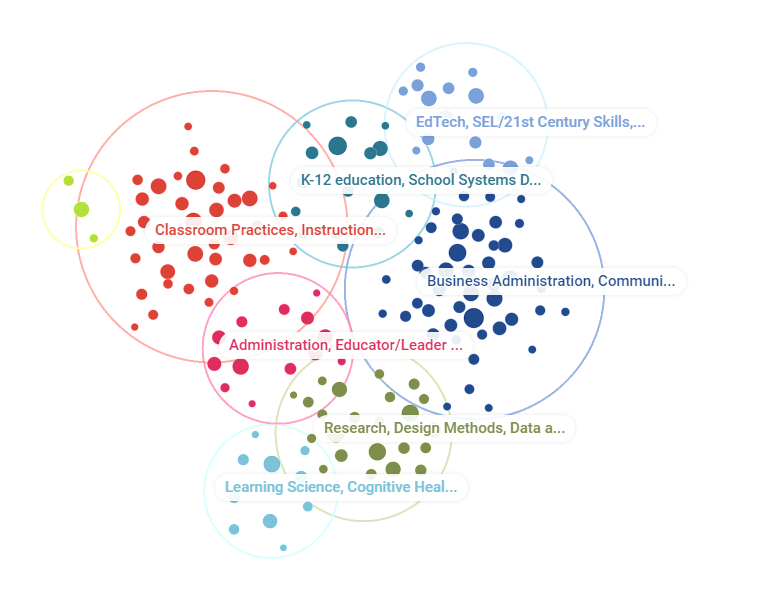
This education R&D map gives us insight into where the field is working but also is a useful convening tool. The map shows us areas of overlap or “clusters” that we might not have been aware of and can be used to find and bring together potential collaborators. For example, if you are hosting a convening on Design Methods then you likely know the players in that space who should attend. Looking at the “Research, Design Methods, Data and Analytics” cluster, however, you may discover additional players who you would not have thought to invite who are working on Research and/or Data and Analytics and who would make valuable contributions to the convening.
What’s Next and How You Can Get Involved
We believe deeply in the power of collaboration and community to share and draw out new ideas. Here are some ways you can join us.
- Explore the map! If you’re eager to dig into more of our approach, have ideas to share, or are even working on another mapping of the education R&D ecosystem, we’d love to hear from you!
- Get on the map! To co-create our future even more robust iterations of the ecosystem map, we want to invite everyone working within education R&D to complete the survey. AERDF plans to analyze new responses and release an updated map in the future.
About AERDF:
Launched in 2021, AERDF is a national nonprofit research and development organization that builds ambitious, inclusive programs aimed at tackling persistent teaching and learning challenges that disproportionately affect Black and Latino students and students of all races experiencing poverty in grades Pre-K-12. AERDF currently runs three programs: EF+Math, Assessment for Good and Reading Reimagined. Each program builds on existing community-driven evidence and learning science to translate fundamental insights into more useful practices, equitable approaches and tools for educators and students.
“Are we honoring student and teacher voices, honoring their perspectives, honoring the push back, honoring the expertise that they bring, in ways that are advancing and shifting a paradigm around product development?”
EF+Math Associate Director of Inclusive R&D Partnerships Adam Smith speaks with EF+Math Executive Leadership Council Member Maxim Vickerie, MS on how teams of educators, researchers, and product developers collaborate and co-design inventions that improve math learning through increasing executive functioning skills.
Both joined Megan A. Sumeracki for a conversation on equity-centered mathematics learning, executive function skills, and our Inclusive Research and Development approach during this episode of The Learning Scientist. EF+Math is one of three Inclusive R&D programs with AERDF.
Portland, Ore. — K-12 assessment and research organization NWEA released today results of a yearlong study examining the effectiveness of a reading fluency intervention targeting struggling middle school readers from historically marginalized populations or those living in poverty. The study was funded by the Reading Reimagined program of the Advanced Education Research and Development Fund (AERDF, pronounced like air-diff), and provided a specific reading fluency protocol along with professional learning to sixth grade teachers in a large, urban U.S. school district in 2022-23.
The findings point to strong outcomes, including:
- Students who scored below the 50th percentile on the Capti Assess Reading Efficiency subtest demonstrated a statistically significant positive difference between the pre- and post-tests after experiencing the protocol.
- Teachers noted observing a positive impact from the protocol on students’ reading abilities, specifically for those students who previously performed below the grade-level expectations for reading.
“Reading fluency is essential for effective reading comprehension at any age, but it’s especially critical once students go from ‘learning to read’ to ‘reading to learn,” said Laura Hansen, Director of Academic Services at NWEA. “Unfortunately many students leave elementary school still not proficient in reading, and that creates a significant barrier to their ability to learn across subjects. Most middle and high school teachers are not trained in the teaching of foundational reading skills (e.g., phonemic awareness, phonics) to address this problem.”
At the center of the study was a new, easy-to-implement protocol for secondary school teachers to use to help increase reading fluency of their students. What makes the protocol easy-to-implement is that teachers can use it with text from any subject matter and do not need any training in reading pedagogy. While the study focused on grade 6, the protocol is designed for use from grade six on. The protocol leveraged Repeated Reading, as well as language strategies at the word and sentence level, and student engagement via culturally relevant passages and goal setting. Most formal reading instruction ends once students leave elementary school, but national data show that almost 70% of eighth graders are not considered proficient in reading based on 2022 test scores on the National Assessment of Educational Progress (NAEP), also known as The Nation’s Report Card. Having researched tools like the protocol featured in this study is a step forward in addressing the challenge of struggling readers past the elementary years, especially those from historically marginalized populations and/or those living in poverty.
“Reading Reimagined is urgently pursuing solutions for foundational literacy skill instruction for students in grades 3-8, who often still need, but rarely receive, ongoing direct instructional support to achieve lasting reading proficiency,” said Reading Reimagined’s Executive Director Rebecca Kockler. “NWEA’s fluency protocol is one of many tools that Reading Reimagined has already and will continue to make freely available to all educators seeking to support their students’ literacy development. We are excited to see it being used in classrooms across the country.”
Read the full report at https://www.nwea.org/resource-center/resource/increasing-fluency-in-middle-school-readers/
About NWEA
NWEA® (a division of HMH) is a mission-driven organization that supports students and educators in more than 146 countries through research, assessment solutions, policy and advocacy services, professional learning and school improvement services that fight for equity, drive classroom impact and push for systemic change in our educational communities. Visit NWEA.org to learn more about how we’re partnering with educators to help all kids learn.
About AERDF
Advanced Education Research & Development Fund (“AERDF” pronounced air-diff) is a national nonprofit R & D organization launched in 2021.
AERDF builds ambitious, inclusive three to five year programs with educators, researchers and developers, aimed at tackling major and persistent teaching and learning challenges that disproportionately affect Black and Latino students and students experiencing poverty in grades PreK-12.
Each AERDF program builds on existing community-driven evidence and expertise as well as learning science to translate fundamental insights into usable knowledge, useful practices, equitable approaches and transformative tools for education practitioners and students. EF+Math was launched successfully by Dr. Melina Uncapher in 2019, and served as a demonstration program that tested the core theory of action that helped launch AERDF, which has since launched two additional programs in 2021 — Assessment for Good and Reading Reimagined. Additional programs are also under consideration, for this year and beyond.
FOR AERDF Contact: Yasmene Mumby, Communications Director, info@aerdf.org
“We want innovation to happen at the edge of what’s possible…we’re aiming for not just statistically significant, but transformative outcomes.” Compelling words from our CEO Auditi Chakravarty in the EdWeek Market Brief article that includes our tri-sector R&D approach and focus on co-designing leading edge teaching and learning solutions with educators, researchers, and developers.
Read on to learn how several other education CEOs weigh in and describe their organizations’ internal and external sources of inspiration.
Oakland, CA: The Advanced Education Research and Development Fund (AERDF) today announced the release of an insights report from its demonstration program, EF+Math, which suggests early signs of promise to improve mathematics learning for its priority populations, Black and Latinx students, and students of all races experiencing poverty. The insights are released as school systems across the country are seeking evidence and equity-driven pathways to support all students in reaching their full potential, especially on the heels of the Covid-19 pandemic.
Launched in 2019, EF+Math aims to help every student to know their innate abilities, know how to use them to take control of their own learning, and be given every opportunity to learn rigorous mathematics. EF+Math’s portfolio of ten R&D teams were brought together through the program’s Inclusive Research and Development (R&D) model, which places an intentional focus on equity throughout the process and centers educators and students as crucial partners from the start, working alongside researchers and developers throughout cycles of design and research. EF+Math points to partnership from its district partners, education leadership council (ELC) and R&D teams as essential to the program’s maturation.
Portfolio teams are currently in the third year of a five year Inclusive R&D cycle to design, build, pilot, and evaluate mathematics learning approaches and new research tools for students in grades 3-8. In EF+Math’s process, students are advancing their conceptual understanding and multi-step problem solving skills, building their identities as mathematical thinkers, and strengthening their executive function (EF) skills. EF skills are core capacities that allow individuals to manage their attention, thoughts, emotions, and behavior.
“We’re seeing evidence that suggests our model is leading to promising, implementable math approaches and new research tools that can improve math learning and EF skills. Early findings suggest the approaches our teams have developed are also supporting students in developing their identity as individuals who are capable of learning and making sense of mathematics, as well as their sense of belonging in math classrooms,” said Aubrey Francisco, EF+Math’s Executive Director. “While we are still early in our journey, I’m proud of the progress our community has made in both creating prototypes that can have that impact on students and shift influential individuals and organizations’ behaviors and actions to be more asset-based and equity-centered.”
“The initial vision for EF+Math began with a compelling research base rooted in learning science. The research reveals that the development of EF skills could be a promising core lever that can benefit students from lower income households more than those from higher income households. In other words, it could be an untapped approach to amplify the math brilliance in students who have been least served by the system,” said Dr. Melina Uncapher, founder of EF+Math and AERDF’s Chief of Research and Development. “What was most novel in this Inclusive R&D model we were pioneering was applying rapid cycle R&D in co-leadership with the research, education and developer sectors, which have traditionally operated in silos – all to produce new solutions that could make a difference in the lives of students.”
EF+Math’s progress contributes to the development of an AERDF organization that is now a place to prototype promising research-based innovations to identify the few that will transform PreK-12. EF+Math was launched just six months into a global pandemic, which heightened a need for the program to build a foundation of deep trust, respect and support given the trauma many members within its 200+community were experiencing.
“EF+Math’s approach is helping to bridge the learning gap that has long existed. Reading EF+Math’s Insights Report further demonstrates how this innovative approach is aiding in shifting mathematical thinking from traditional to a 21st century style learning,” said Pedro Rodriguez, a middle school math teacher with the New York City Department of Education and a member of EF+Math’s Educator Leadership Council. “EF+Math has helped to cement my own core beliefs on students’ education. Through council and co-design meetings, I now feel better prepared to champion these conversations to local leaders in NYC, especially in the Harlem and Washington Heights area.”
Luis Torres, a lead math teacher from Santa Ana, California added, “EF+Math is a truly holistic and inclusive approach that positions educators and students at the center of the design process. We are taking everything into consideration to ensure all students are able to have positive mathematical identities and design equitable and rigorous math tasks to support our most vulnerable students. It has helped students with their math identity and removes additional barriers. We implement adaptable executive function skills and strategies that meet the needs of my diverse students.”
EF+Math Report Insights
After many iterations of R&D in co-leadership with educators and students, EF+Math project teams have developed novel mathematics learning approaches and begun testing their scientific hypotheses about the relationship between EF and mathematics through pilot studies in classrooms across the country. Below are insights from the work as a whole portfolio based on teams’ early results. See the full report here.
- EF+Math approaches show promise for improving student learning.
- When educators and students are involved at every stage of the R&D process, learning approaches are more relevant to the classroom.
- Student mathematics learning outcomes are improved when executive function skills are strengthened alongside positive student beliefs.
- Effectively building students’ executive function skills during mathematics learning requires new instructional strategies, tools, and assessments.
- New student-centered tools and assessments emerge when diverse teams focus on designing for equity.
- Centering equity from the beginning leads to mindset shifts and a culture of equity and inclusion throughout the process.
These insights are intended to inspire researchers, educators and developers in their own work and to consider joining EF+Math as partners in its next phase of work or as part of a larger community shifting to Inclusive R&D processes.
EF+Math will share information about a webinar it plans to host soon that will engage education researchers, math educators, product developers and others interested in learning more about the report’s findings and their application for classrooms today. Sign up here to stay informed of EF+Math updates and updates about initiatives across AERDF.
About EF+Math and the Advanced Education Research and Development Fund (AERDF)
EF+Math is an advanced Inclusive R&D program that supports teams of educators, researchers, and developers to co-create rigorous math learning approaches that improve learning outcomes and affirm the brilliance of Black and Latinx students and students experiencing poverty. EF+Math was launched in 2019, and serves as a demonstration program for AERDF. AERDF is a national nonprofit R&D organization launched in 2021 that builds ambitious, inclusive three to five year programs with education practitioners, researchers and developers, aimed at tackling major and persistent teaching and learning challenges that disproportionately affect Black and Latino students and students of all races experiencing poverty in grades Pre-K-12. Each program builds on existing community-driven evidence and expertise as well as learning science to translate fundamental insights into usable knowledge, useful practices, equitable approaches and transformative tools for education practitioners and students. AERDF produced two additional programs in 2021 – Assessment for Good and Reading Reimagined. Additional programs are also under consideration, for this year and beyond.
Contact Information:
Advanced Education Research
and Development Fund (AERDF)
Marvin Smith
msmith@aerdf.org
Release Date:
March 30, 2023
 Oakland, CA: The Advanced Education Research and Development Fund (AERDF) today announced that Auditi Chakravarty will assume the role of CEO, starting on April 3, 2023. Chakravarty succeeds founding CEO Stacey Childress, who steered the successful transition from a demonstration program at NewSchools Venture Fund in 2019 to a standalone nonprofit research and development (R&D) organization launched in July 2021.
Chakravarty joins AERDF in the midst of rising national momentum for greater adoption of education R&D as our education systems seek to make gains following the Covid-19 pandemic. A recent $40M allocation to the U.S. Department of Education’s Institute of Education Sciences (IES) and a proposal of $45M in new funds to IES contained within President Biden’s FY2024 budget are signs of increasing attention on this emerging field. Speaking to Chakravarty as a leader for this time, AERDF Board Co-chair and Former U.S. Deputy Secretary of Education Jim Shelton said “Auditi’s deep expertise in leading ambitious education innovation will add an important perspective to the national discussion on how to utilize advanced education R&D, as other sectors have, to imagine and build expeditiously toward optimal learning experiences for our students.”
“Auditi’s leadership in the education innovation field will be pivotal in elevating our ‘inclusive R&D’ model as an engine of innovation serving our priority students,” says Dr. Melina Uncapher, chief of research and development at AERDF and founder of its demonstration program EF+Math.
As a former educator and leader who fiercely embraces academic potential in students of all identities and abilities, Chakravarty has built successful products and services that have reached classrooms across the country. From her time as a high-school English teacher to most recently as Senior Vice President of Learning and Assessment at College Board, Chakravarty knows the impact well-designed instruction and assessment can have in the classroom and on students’ lives.
She has built and launched instructional programs in senior roles at Kaplan and subsequently within College Board’s AP, Springboard, and Pre-AP programs, where her focus was driving AP access and readiness. She holds a BA in English and a master’s degree in education from the University of Illinois at Urbana-Champaign.
As AERDF approaches two years since its launch, Chakravarty is excited by what she sees as the organization’s unique strength – breaking down the silos between the research, education and product development sectors to identify and collectively build toward teaching and learning solutions that improve student well-being and academic outcomes. Chakravarty shared “as legions of advocates work together to shape the future of education R&D, I am excited about a role for AERDF to orchestrate stronger collaboration, efficiency and momentum, driven in part by ongoing learning within our Inclusive R&D programs.”
Chakravarty knows that education R&D, at its core, is about identifying rigorous research-based levers that show us what works for our nation’s students and from that learning, building new products and programs that meet the needs of students and educators. “Auditi has deep experience with and respect for the role of a robust research agenda within an iterative, inclusively-led and rapid cycle R&D environment like we have at AERDF,” said AERDF Board Co-chair and President of the Spencer Foundation Dr. Na’ilah Nasir. “I’m confident her leadership will help serve as a bridge for the too-often siloed communities of researchers, PreK-12 practitioners and product and program developers.”
Chakravarty is eager to step up at this moment of opportunity. Her first priorities are a listening orientation within the AERDF community, focused learning on the biggest opportunities and challenges within AERDF and across the sector, and continuing the commitment to create learning environments for all children to thrive, particularly Black and Latino students and students of all races experiencing poverty, who have been historically and systematically excluded from equal opportunity in education.
“Recruiting a long-term CEO has always been the plan, following what was a successful incubation and launch under the NewSchools umbrella,” said Founding CEO Stacey Childress, who transitioned out of AERDF in December. “I’m thrilled for what Auditi’s leadership means for the organization’s next chapter and I look forward to supporting a smooth transition.”
Chakravarty will join the AERDF team on April 3 and soon begin dialogue with organizational allies and sector leaders whose experience and perspectives are critical to AERDF’s success in the ecosystem. Join AERDF’s Community Garden to stay informed of the organization’s ongoing work and to engage with topics of interest.
About the Advanced Education Research and Development Fund (AERDF): AERDF is a national nonprofit R&D organization launched in 2021 that builds ambitious, inclusive three to five year programs with education practitioners, researchers and developers, aimed at tackling major and persistent teaching and learning challenges that disproportionately affect Black and Latino students and students of all races experiencing poverty in grades Pre-K-12. Each program builds on existing community-driven evidence and expertise as well as learning science to translate fundamental insights into usable knowledge, useful practices, equitable approaches and transformative tools for education practitioners and students. EF+Math was launched successfully by Dr. Melina Uncapher in 2019, and served as a demonstration program that tested the core theory of action that helped launch AERDF, which has since produced two additional programs in 2021 – Assessment for Good and Reading Reimagined. Additional programs are also under consideration, for this year and beyond.
Often, when older elementary school students can’t read, it’s because they’re having trouble with a foundational skill, said Brandy Nelson, the academic director for the Reading Reimagined program at the Advanced Education Research and Development Fund.
“What is probably happening is the student has a decoding challenge,” she said.
Read on to learn what school systems need to do to support older students who have reading difficulties.