Education R&D can fuel technological and scientific breakthroughs that unlock innovative teaching methods and improve student outcomes, positioning all students to adapt and thrive in a rapidly changing world. An investment in education R&D is an investment in our nation’s economic growth and global leadership.
The Advanced Education Research and Development Fund champions the power of research and development to unlock scientific breakthroughs and deliver research-backed solutions to pressing teaching and learning challenges.
Read the article to learn how deepening investment in education R&D can pay dividends, and what a pathway forward can look like.
Decades of research show that when learning is fun, it’s not only more effective but also keeps young people truly engaged. Building on this research, Dr. Andres Bustamante and his team at UC Irvine are combining community partnership, cultural context, and play to transform everyday spaces like parks, bus stops, and local markets into vibrant hubs for learning all across Santa Ana, California.
Recently, Dr. Bustamante was invited onto the UC Irvine Podcast to discuss his work with Playful Learning Landscapes: common places where families and community members naturally gather that are designed to invite play and learning. He shared how his team is partnering with communities to ensure that these learning opportunities are deeply rooted in local values, cultural practices, and familiar routines. This ensures the installations are effective, useful, and sustainable to the local community where they are present.
One such installation is Fraction Ball. Designed at the suggestion of teachers at El Sol Academy, Fraction Ball integrates fractions into the three-point arc and smaller arcs on the basketball court, creating a hands-on, engaging way for students to understand fractions. The court features both fraction and decimal representations, helping students visualize their equivalence. Rational numbers, like fractions and decimals, are notoriously challenging for students, yet they are foundational for future success in math learning, especially for algebra.
With funding support from EF+Math, a program of the Advanced Education Research and Development Fund (AERDF), and in partnership with the Santa Ana School District, Fraction Ball has been introduced to 5,000 students across 27 schools. Initial experimental studies conducted over the last five years have consistently shown strong positive impacts on student learning.
Listen to the podcast to learn more about Dr. Bustamante’s work and the success of Fraction Ball so far.
Math skills are and will remain in high demand in the job market, so it’s critical that students experience rich math learning experiences, in school and beyond, that build their confidence as math learners. In a recent Education Week article, AERDF president and CEO, Auditi Chakravarty asks us to consider, “What kind of exposure do kids get at a really young age to numbers and numeracy to build that same kind of literacy [as reading readiness]?” Providing all young people with opportunities to build mathematical proficiency will support their academic achievement and create pathways to a wide variety of careers.
As such, it’s of great concern when recent NAEP scores indicate that nearly 40% of 8th graders and almost 25% of 4th graders in the U.S. are below basic proficiency in math. One reason this may be the case is math anxiety. What’s described as a learned emotional response to math-related activities, math anxiety is said to affect 20-30% of students. Math anxiety can look like feeling blank, sweating palms, and a racing heartbeat when faced with math problems.
Co-executive director of EF+Math, a program of AERDF, Michelle Tiu, recommends mastering basic math facts and focusing on conceptual understanding over math drills and timed tasks to promote math fluency. “Not possessing fluency adds a lot of cognitive load to each step of a mathematical process. If students’ cognitive load is not taken up with thinking about basic fluency facts, it frees them up to be able to focus on higher-order thinking and conceptual understanding.”
Read the article to learn more about evidence-based strategies to mitigate math anxiety and improve student learning.

Introduction
Lifelong learning starts with self-awareness. When students recognize their strengths and understand how they shape their learning, they don’t just participate—they take ownership. That’s why student co-design is at the heart of Assessment for Good’s (AFG) work. By collaborating with learners, we ensure that assessments reflect their experiences, needs, and potential. To dive deeper into this approach, we are excited to talk with Dr. Lauren D. Kendall Brooks, Research Scientist for AFG, who has led many student interviews and focus groups that shape both the development of assessment constructs and the design of assessment environments. In this conversation, she shares more about AFG’s approach to collaborating and codesigning with students to co-create meaningful assessments, and shares stories of students playing an active role in their own learning, and ours!
What is assessment and why is it the focus of AFG?
Assessment tells us what’s important to our culture. Traditionally, if a student studies something that isn’t on the test, it’s often framed as studying the “wrong” thing, rather than a reflection of their learning. This is the nature of summative assessment. At AFG, we aim to impact formative assessment, which is a type of assessment that focuses on understanding what students know and are learning in the moment–allowing educators and caregivers to intervene and support students in real time.
What does it mean for assessment to be inclusive and effective?
Formative assessment is inclusive when students are able to show what they know in ways that are authentic to how they learn and understand the world. Assessing them in environments that feel comfortable for them, safe for them, and in ways they’re able to best express themselves, makes it effective. Assessment should provide students with information that supports continual learning. Traditionally, assessment is thought of as the end of learning when it is actually just the beginning – the beginning of being able to use the knowledge that you’ve gained to shape your learning journey.
How is AFG engaging in assessment development and design differently?
We see our students as people, not numbers or data points. Their perspectives matter because they are the experts of their own lived experience–they understand how they learn and process information better than we ever could. By combining our expertise in assessment and students’ deep understanding of themselves, we find that middle ground where their voices shape what and how we measure.
This became especially clear to me in a conversation with a student when I used the phrase, “students like you.” She immediately questioned it: “What does that mean? Like other third-grade Black girls?” I paused and clarified, “No, I mean students who may share your interests or preferences.” But she made it clear—she didn’t see herself as similar to other third-grade Black girls in that way. By the end of the interview, I recognized what she meant. I also realized there were likely thousands of other third grade Black girls who, like her, don’t feel seen.
Her insights directly influenced the questions we included in our assessment. I had planned to invite her to participate in product testing–where we work with students to test and refine our playful assessment tools–but when I asked her if she wanted to play a game next time, she surprisingly replied, “No – I want to keep doing this because sometimes kids that are different like me need help with these questions.” She saw herself as a real voice for other third grade students who don’t enjoy assessment. This is exactly why we listen.
A cornerstone of AFG’s approach is codesign. How do you define it?
Codesign is working with and for students. Codesign is collaborating with partners from the start, giving them the roughest version of a plan, a research question, or prototype and asking questions like: “Am I in the right direction?” “Can you show this to me?” “What do you think about this?” “How would you change it?” “Does this even make sense?”
It’s giving them a storyboard idea before you get to a prototype, or a drawing on a page before they are given something they can touch and feel, and asking them to co-create the path forward.
How are students who are a part of AFG’s codesign process affected by this engagement?
Students get really excited. I will have heard feedback from five different students on that same day, each eager to share their thoughts. By letting them know that their input is valued, I find that I get to the richness of codesign. It’s them correcting me, showing me, teaching me. “Actually, we would use this word instead.” “That word doesn’t make sense here.”, “I would change this.” , “This looks weird.” , “It reminds me of this negative thing” (like a TV show or video game).
I think this allows them to feel valued–they see their voices shaping something real, something that will reach others. I always ask them, “What does it feel like to know that you have given feedback on something that will help thousands of kids?” Their responses are powerful:
- “This is really important because not everyone has someone to talk to.”
- “Sometimes people have problems and they don’t know where to go and this may help them think about things differently.”
- “Kids don’t have anybody to talk to and this may be a safe place. Not everybody has that like I do.”
They start getting very deep. They want to help other people because they recognize that not everyone has a trusted adult and this could help and support them.

It’s apparent that trust is crucial in order to codesign effectively. How do you approach building trust with students?
I am as honest with them as possible. I try to give them agency up front, reminding them repeatedly that they don’t have participate. I read them their consent form and give them a chance to ask questions. I let them know what is going to happen along the way at each step. They can choose not to answer any of my questions. We use pseudonyms for anonymity–they come up with some fun ones–but I always make sure to remember their real name at the end. I thank them for being there before they go.
It’s also important to allow them to see the mistakes in the prototype. They have seen my spelling errors, perhaps doubling a question. When they point out the mistakes, they see that this is a real prototype, and know that I am really listening to them. I hear a lot of the same things, but I always ask them to keep going. I ask them to clarify, which validates their responses. We have conversations about what they mean exactly. They get to correct me. Eventually, they give me lots of explanation without me having to prompt them. I love when we students come back because they can see the changes that have taken place. They can see that they are part of the process.
Conclusion
Through co-design, students move beyond being research participants—they become collaborators, shaping something bigger than themselves. When we truly listen, we don’t just build better assessments—we help students see their own power in shaping the world around them. At AFG, we are excited to continue engaging students, educators and their caregivers in codesigning asset based, formative assessments that measure the critical skill that power learning–we look forward to sharing what we’re learning along the way!
The fourth installation in our EF+Math blog series is the final piece featuring our incredible project teams, this one focuses on Fraction Ball.
Introduction to Fraction Ball
As we announced in our opening blog of this series, Fraction Ball is one of three teams in the EF+Math portfolio that is continuing to develop and study our core hypothesis. The EF+Math program is investigating the big idea that the integration of executive function (EF) skill development in math learning approaches that address conceptual understanding and complex problem solving, in ways that afford equitable experiences in math learning, can dramatically increase students’ math outcomes. Each advancing team uniquely addresses the intersection of EF, mathematics, and equity, helping to answer EF+Math’s hypothesis and inform continued research and development in this intersection.
The visual below may help in understanding the complementary nature of each approach in the EF+Math Program’s portfolio.

Fraction Ball is an integral part of EF+Math’s portfolio approach as an innovative program that is reimagining how students learn fractions by combining physical movement, play, and mathematical thinking in uniquely engaging ways.
The Fraction Ball team addresses the long-standing challenge of teaching fractions, considered a crucial yet challenging gateway to advanced mathematical understanding, through its games which emphasize a playful learning approach, math-related emotions, fun, and collaboration. Math learning can elicit many emotions for students; Fraction Ball invites those emotions as part of the play and learning process. Further, Fraction Ball aims to increase the positive emotions, like joy and happiness, that students associate with doing mathematics, and decrease feelings of negative emotions, such as anxiety or stress. Fraction Ball implicitly supports students’ use of executive function skills in rational number learning contexts. Their work is also deepening our understanding of embodied cognition and students’ math-related emotions.
The Promise of Fraction Ball: Reimagining Fraction Learning Through Play
Fraction Ball’s focus on joy and play is unique and is a bright spot in innovative math learning. Bringing joy and play into math is novel in the field and intentionally designing for a playful context for math learning is transformational. This works to shift the mindset around math from something “boring” to something “fun”. And, research consistently demonstrates that mastery of fractions is crucial for future mathematical success. Often described as the “gatekeepers” to algebra, fractions and decimals represent a critical juncture in students’ mathematical journey. Fraction Ball’s approach is a promising solution for improving students’ learning outcomes on fractions.
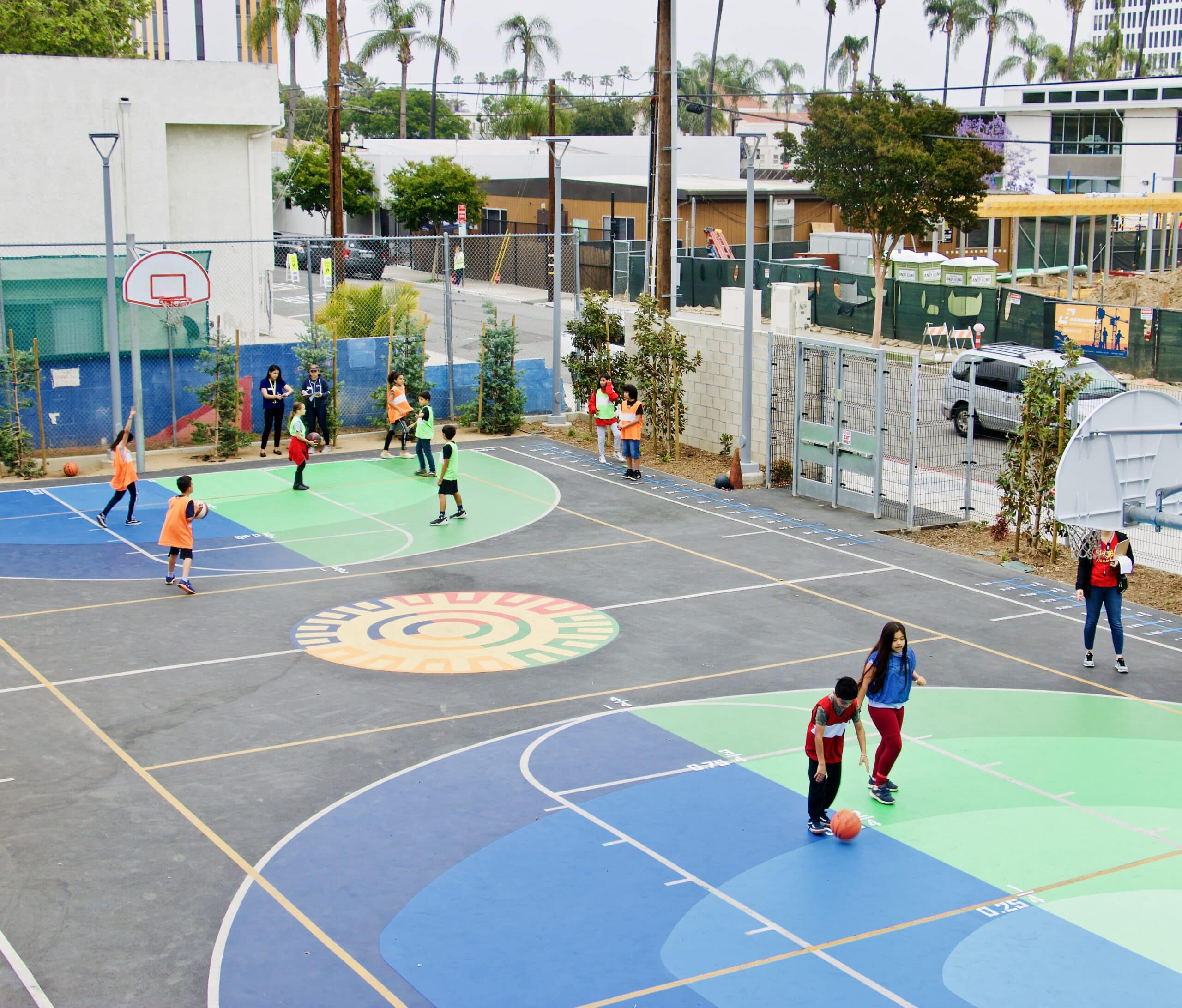 Photo. Kenny Lewis
Fraction Ball’s program consists of a comprehensive 16-lesson unit, split between classroom activities and basketball court-based games, each running for 50 minutes. What makes Fraction Ball particularly special is its integration of rational number concepts into basketball-inspired games, complete with colorful court markings displaying fraction and decimal representations (e.g., 1/4-point, 1/2-point arcs) with an accompanying number line on the side of the court for scoring.
The program tackles key mathematical concepts that traditionally challenge students, including:
– Rational number understanding, including magnitude comparison
– Addition of fractions and decimals
– Translation between fraction and decimal representations by the placement of numbers on 0-to-1 and 0-to-5 number lines
We know rational numbers are an area where challenges come up in student reasoning, which impacts their executive function skills and their ability to try new strategies to solve problems. When learning fractions, we see one of the earliest examples of students changing and shifting what they know about math. They started to learn about the number line, addition, and subtraction. As their math learning advances, they are introduced to the notion that the ways they add and subtract are different than with whole numbers, and this shifts students’ understanding of what numbers mean. Fraction Ball offers opportunities for students to adaptively monitor, plan, update, and shift thinking within reasoning about rational numbers in basketball games and strategies.
What sets Fraction Ball apart is its commitment to “embodied learning” – a pedagogical approach that connects physical movement with mathematical understanding. By integrating basketball-inspired games with rational number point values and visual representations on the court, students engage with mathematical concepts in a tangible way. Fraction Ball games and lessons also aim to improve students’ math-related emotions and teamwork through collaborative learning.
The results are promising. Studies have shown that students participating in Fraction Ball demonstrate significant improvements in their rational number understanding, including their ability to add fractions and decimals, translate between fractions and decimal representations, and place fractions and decimals on 0 to 1 and 0 to 5 number lines. These results suggest that Fraction Ball’s approach to supporting EF skill use within physically engaging and game-based activities is impactful for math learning.
The program’s impact extends beyond mathematical comprehension. Research has revealed a notable decrease in negative emotions related to math among participants, alongside improvements in student confidence and self-efficacy. The collaborative nature of the games also promotes teamwork and positive social interactions, creating a supportive learning environment.
One of the program’s exciting additional research findings is its success in achieving results in students’ far transfer – the ability of students to learn something with one set of numbers and use them with a new set of numbers. This is a challenge in math education and Fraction Ball is moving the needle on this.
The Impact of Inclusive Research & Development Processes
The development of Fraction Ball’s games, curriculum, and activities is driven by the team’s commitment to equity, leading to unique product developments and findings. The program has been shaped by deep partnerships with local educational organizations and institutions, and perhaps most importantly, through direct collaboration and co-design with students and teachers.
A striking example of this collaborative approach comes from a group of female students known as the Femineers. Seeking to improve accessibility, these students developed an indoor version of the game using bottle caps. This adaptation was incorporated into the full unit and contributed to improved far-transfer results in subsequent studies.
The program benefited from extensive cooperation with mathematics curriculum specialists, school principals, and educators to ensure alignment with district goals and practical implementation needs. This has led to several valuable adaptations, including:
– Curriculum guides that integrate with existing district scope and sequence
– Classroom activities complementing court-based learning
– Addition of a “Tracker” role for data analysis
– Grade-level differentiation to ensure challenging experiences for returning students
The Fraction Ball team is led by a diverse team of educators and scholars, including the majority of project team members as leaders of color. The team has a deep commitment to building the leadership capacity of graduate students, and educators they work with.
What’s Next?
Currently implemented in over 40 schools across four Southern California districts, Fraction Ball continues to expand its reach and impact. Ongoing evaluation studies, including a larger-scale randomized control trial (RCT) study, are being conducted to further validate the program’s effectiveness in improving fraction knowledge.
Through Juego (gojuego.com), the team is working to scale their playful learning model to reach more students and educators. Plans are also underway to expand the program’s content into surrounding grade levels through initiatives like Number Ball. The team also developed a Fraction Ball video game which offers educators valuable insights into their students’ fraction and executive function abilities through an assessment via gameplay features. This “stealth” assessment gathers data useful to researchers and educators, while avoiding testing burden on students or invoking test anxiety
As mathematics educators continue to seek innovative ways to engage students and improve learning outcomes, Fraction Ball stands as a shining example of how movement, play, and mathematical thinking can come together to create transformative educational experiences. By making mathematics not just accessible but genuinely enjoyable, Fraction Ball is helping to reshape students’ relationship with mathematical learning, one game at a time.
AugmentED now has its own home: aerdf.org/augmented.
AERDF was founded to unlock scientific breakthroughs and advance research-backed solutions to pressing challenges in PreK-12 education. Last year, we launched a search for our next program. Our call attracted close to 400 proposals at the cutting edge of education, with strong potential for discovering new capabilities that would significantly improve our teaching, learning and assessment systems.
We’re proud to introduce AERDF’s newest program.
Founded and led by Sherry Lachman and Caitlin Mills, AugmentED tackles one of education’s most urgent challenges: how to harness the power of AI to transform teaching and learning. While much of today’s conversation centers on using AI to make current approaches to education more efficient, AugmentED will bring together expert educators, researchers, and technologists to reimagine the role of educators and the learning experiences of students for the age of AI and co-create AI-powered tools to support this transformation.
Our Vision
AugmentED envisions a future where teachers and AI work in harmony to nurture the full potential of all students. This vision imagines educators in a new role: as conductors of a symphony of learning, managing an orchestra of students and AI-powered tools to transform student outcomes. Educators, for example, might use one AI tool for personalized projects, another to guide group collaboration, and a third to run engaging simulations. With data and support from these tools, educators will better tailor their instruction to their students’ needs and spend more time motivating and building relationships with students in ways only humans can.
A Path toward Reimagining Teaching and Learning for the Age of AI
Joining our three existing programs, AugmentED will leverage AERDF’s Advanced R&D model to generate new scientific research and build dynamic prototypes. Unlike traditional technology efforts that engage teachers as product testers, AugmentED will put teachers in the driver’s seat from day one as true co-designers. Throughout the initiative’s lifecycle, AugmentED will partner with expert teachers, cutting edge researchers, and technologists to:
- Reimagine the roles of educators by designing innovative and AI-enhanced approaches to teaching that will equip students with future-ready skills.
- Co-design AI-powered tools alongside more effective teaching approaches to accelerate student learning and support teachers in their new roles.
- Iterate on and refine innovations in classroom settings to ensure they are effective and scalable across learning contexts.
- Generate research insights and share them widely, building an open community where educators, researchers, and technologists can learn from and build on our discoveries.
Meet the Founder, Executive Director of AugmentED

Sherry Lachman
A policymaker, lawyer, and social entrepreneur, Sherry has served in senior White House roles in two presidential administrations, focusing on education, labor, and social services. She has also led social impact initiatives at OpenAI, founded Foster America, a nonprofit dedicated to reforming the U.S. child welfare system, and served as a senior education advisor in the U.S. Senate and Department of Education.
And the Co-Founder, Chief Research and Impact Officer

Caitlin Mills, PhD
A researcher at the intersection of psychology, computer science, and education, Caitlin is an Associate Professor in the Department of Educational Psychology at the University of Minnesota. Her lab focuses on mind wandering, engagement, and emotions during learning with multi-method approaches to inform theory and practice.
What’s Next for AugmentED
In the coming months, AugmentED will be seeking partners in education, research, and technology to join us in reimagining education for the age of generative AI. By combining the best of AI with the best of teacher instruction, we can create a future where every child—regardless of background—has access to an education that prepares them for a rapidly evolving world.
Let’s co-create the future of learning, together.
Despite their best efforts and persistent interventions, educators know that many older students still struggle to read and understand grade-level texts. A recent study suggests that many older students may be struggling with decoding, a crucial foundational literacy skill where readers identify and understand unknown words by breaking them down and sounding them out. The study by AERDF and ETS identified a “decoding threshold,” revealing that students in grades 3-12 who struggle with decoding also make slower progress in crucial reading skills like vocabulary, sentence processing, and comprehension.
This study calls us to reconsider how we approach both reading instruction and assessment for older students. Upper elementary and middle school teachers need foundational literacy assessments and resources that address more advanced decoding skills than what is typically covered in early elementary grades. However, because foundational literacy instruction and assessment typically ends by third grade, these educators are left without training or resources to identify the students who are struggling with these foundational skills. Additionally, many available comprehensive reading assessments for older readers require trained clinicians and are time-intensive, which further limits their use in schools with constrained resources.
Reading Reimagined, a program of AERDF, brought together partners from Stanford University Graduate School of Education and the Achievement Network (ANet) to test an assessment tool in schools that can help educators identify older students struggling to read. Their partnership has pioneered the implementation of an effective and efficient assessment tool that accurately measures reading skills in older students. We are excited to introduce the Stanford University Rapid Online Assessment of Reading (ROAR)!
Stanford’s ROAR tool is:
- Free: the assessment is available at no cost.
- Accessible: ROAR is a self-administered assessment that can be completed online by students within 15 minutes, without requiring extensive training or resources from teachers.
- Effective and research-backed: ROAR is one of two validated reading assessments for students across grades K-12. Research demonstrates its strong correlation with scores from traditional standardized reading tests, like the Woodcock-Johnson Letter Word Identification test, at a fraction of the time.
- Quick and efficient at scale: ROAR offers a fast and reliable way to assess students’ foundational literacy skills on a large scale, helping educators track reading ability and progress across grade levels.
Experience ROAR for yourself! Test out the individual assessments within the tool, and see how ROAR can benefit the learners in your life.

All students can be confident, successful readers with the proper support. The ROAR assessment can help identify the reading challenges older students face so educators and district leaders can plan for the support that most effectively aligns with their students’ needs. Reading Reimagined and its partners are taking a crucial first step to providing educators with resources that help learners on their journey to becoming proficient readers.
What happens when a high school student who struggles to read graduates? They are likely to become an adult who still struggles to read.
A recent article by the Hill emphasizes the detrimental impacts of illiteracy not just in childhood, but into adulthood and across generations: “Studies have shown that low literacy rates exacerbate everything from poverty and health care to low civic engagement.”
The lasting effects of illiteracy are too grave for us to continue as we have for decades. We must reevaluate the way we teach foundational literacy skills in the U.S. education system.
Traditionally, foundational literacy instruction is focused on grades Pre-K through third grade. That means even though teachers in upper elementary, middle and high school may notice their students struggling to comprehend grade-level texts, they are not trained or resourced to teach foundational literacy skills. They also have limited access to assessment tools that both identify the students who are struggling to read and pinpoint why.
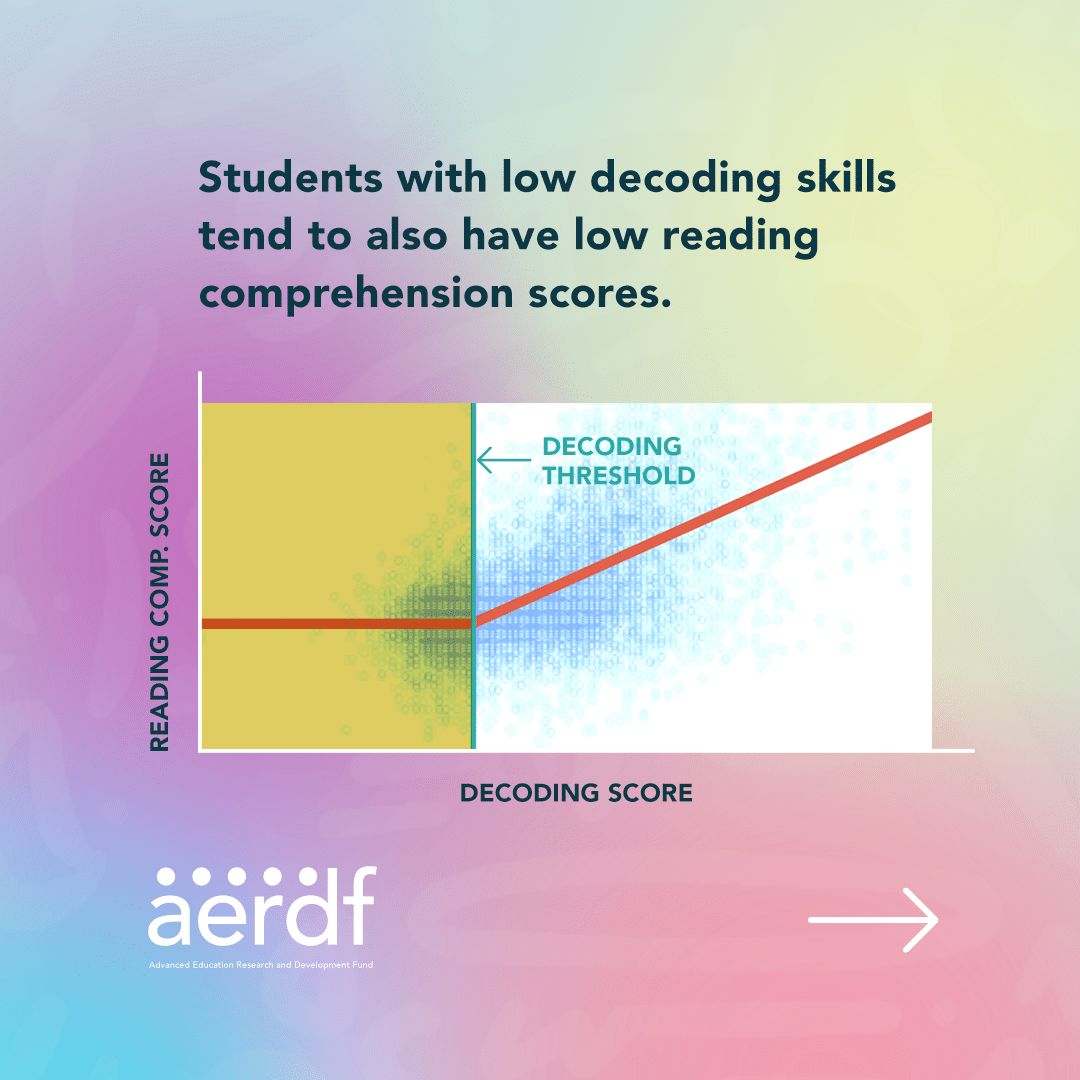
There are many reasons why learners are struggling to read. One main reason is readers cannot sufficiently decode the increasingly complex words they encounter in middle and high school. Decoding is a foundational literacy skill where students break down and sound out novel words to understand them. In 2024, ETS and AERDF published a study that confirmed a decoding threshold: a critical level of decoding skills needed to read and understand grade-level texts. Older students with low decoding skills who fall below this threshold also tend to have low reading comprehension.
Whether you’re an educator, researcher, or policy maker, the implications of this study are far reaching and urge us to rethink how we address illiteracy in this country. AERDF’s program, Reading Reimagined, is investigating and co-designing solutions that will help end illiteracy, so all learners have the opportunity to be confident, proficient readers in school, at work, and beyond.
Read the article here.
As 2024 comes to a close, we at AERDF are proud to reflect on a year marked by promising breakthroughs and measurable progress toward discovering and advancing research-backed solutions to pressing challenges in PreK-12 education. As we chart a course for the year ahead, AERDF remains committed to advancing evidence-based solutions and cutting-edge interventions that boost learning outcomes, honor the perspectives of students and educators, and position all learners to thrive.
Our gratitude goes out to the powerful network of district partners, educators, and learners that makes our work possible. With your help this year, we were able to illuminate new science and technological breakthroughs and witness tangible, meaningful change in classrooms across the country. Together, we are pushing the boundaries of scientific possibilities in education to better serve learners and teachers everywhere.
Here are a few highlights from this pivotal year:
Uplifting Program Successes
AERDF programs operate on a five-year cycle to develop scientific insights, technical advancements, and prototypes that address major teaching and learning challenges and opportunities within their area of focus. Below is a snapshot of our program teams—each at a different point in their AERDF program lifecycle—and their recent successes.
Piloting Transformative Math Learning Approaches with EF+Math
Every student is a powerful learner capable of success in math. The innate assets they bring to the classroom–cultural wealth, lived experience, and executive function skills–need only be honored and activated to help them succeed. AERDF’s inaugural program, EF+Math, is proof of this. Their current three R&D teams, Fraction Ball, MathicSTEAM, and CueThinkEF+, are generating evidence-based solutions proving that creating math learning experiences that bring out the innate skills inside every student can improve math outcomes for all learners.
Earlier this year, the EF+Math team presented at the National Council for Teachers of Mathematics (NCTM). There, the teams shared how they are co-creating and implementing math learning breakthroughs, alongside educators, researchers, and developers, that allow students to showcase their assets in the math classroom. Watch the video and hear directly from researchers and educators about:
- CueThinkEF+’s AI-powered problem-solving and collaboration platform improving learners’ critical mathematical thinking skills
- Fraction Ball transforming basketball courts into interactive math games, teaching fractions through movement, significantly improving students’ understanding of rational numbers, and seeing higher overall accuracy scores
- MathicSTEAM co-designing curricular materials with educators and students to drive improvements in MIND Research’s neuroscience-based core K-6 curriculum called Insights Math and their development of a digital game-based app that provides opportunities to deepen students’ math fact fluency while simultaneously strengthening their executive function skills, like working memory.
Charting a Course for More Meaningful Assessment with Assessment For Good
A student’s learning experience is about more than just mastering subject content. It also involves building confidence, self-awareness, and motivation as they encounter exciting and challenging opportunities in the classroom, at home, and in their communities. AERDF’s program, Assessment for Good (AFG), has identified 30 key skills that maximize growth and learning in the classroom and beyond. AFG is designing and testing assessment prototypes that measure the skills that enhance learning for all students, everywhere learning happens.
In a recent webinar with EdSurge, Dr. Temple Lovelace—Program Executive Director of AFG—shared the program’s vision for assessment that captures student learning as it’s happening. With this approach, we can measure the skills students use to learn–like perseverance and confidence–as well as the content they’re learning. Learn how AFG, alongside learners, caregivers, and educators, is working to make such assessment tools possible.

Driving Literacy Forward with Reading Reimagined
AERDF’s program, Reading Reimagined—now nearing its midway point—recently unveiled groundbreaking research in partnership with ETS to shed light on why many older students are struggling to read. The study underlines the importance of decoding—a crucial foundational literacy skill where readers identify and understand unknown words by breaking them down and sounding them out. Students who lack this critical skill fall below the “decoding threshold”—and show slower progress in vocabulary, sentence processing, and comprehension.
These findings underscore the urgent need for programs like Reading Reimagined that develop breakthrough, classroom-tested approaches to support struggling readers of all ages. In an August 2024 New York Times article, Program Executive Director Rebecca Kockler gave her perspective on how the national movement to rethink reading has largely left out a generation of older students who are behind in literacy—and who will not recover without extra help.
Dare to Dream: The AERDF AdvancED Fellowship to Prove the Impossible
In April 2024, AERDF launched a nationwide search for the next big idea with the power to transform how all children learn. Out of nearly 1,000 incredible applicants, a select group of fellows were invited to participate in our AdvancED Fellowship—uniting visionary leaders across disciplines to hone their ideas with the support of experts across learning science, development, technology, educator practice, policy, and more. We look forward to sharing what we learned about the state of the art in education through this fellowship.
Stay tuned for the launch of AERDF’s next program and news of the talented executive director who will pursue courageous and ambitious solutions that produce transformative outcomes for all learners.
Scaling AERDF’s Influence at the National Level
In addition to being selected as one of Fast Company’s 2024 World Changing Ideas, AERDF was honored to present at some of the nation’s most prestigious education and innovation events this past year—including ASU+GSV Summit 2024, ISTELive 2024, NCTM, and AERA Annual Meeting 2024. We are excited to continue bringing this essential work to the forefront of national conversations about innovation and impact in education.
Relive our time at ISTELive:
As we enter 2025, we’re ready to build on this year’s momentum, deepening our commitment to advancing education solutions that are both transformative and inclusive of learner and teacher perspectives. Together, we will continue to innovate, collaborate, and create opportunities for every learner to thrive.
It’s a well-worn adage in education that students first learn to read, and then read to learn.
At some point, usually around 3rd grade, school systems assume that children have the basics down. They start requiring kids to read increasingly complex text across subject areas. But new research shows that many older students lack critical foundational skills, limiting how far they can progress in their reading abilities as the volume and variety of text grows steeper.
The study from researchers at ETS, a testing organization, and the Advanced Education Research and Development Fund, a group that creates research programs to support Black, Latino, and low-income students, confirms the idea of a “decoding threshold”—a baseline ability to sound out words that students need in order to make good progress on other literacy skills.
Kids who don’t meet this threshold see slower growth in their reading ability than their peers, the researchers found, which can lead to compounding gaps over time.
Read the rest of the article.