AI has generated a lot of excitement for its potential to solve some of the most pressing challenges in education: individualized instruction, accelerating feedback loops, and more. Our responsibility is not to stop it–AI is already transforming teaching and learning. Our responsibility is to provide the criteria, guardrails, and opportunities for continuous improvement that enable responsible and effective AI integration into our classrooms.
AERDF, Education First, and the Alliance for Learning Innovation have taken the first step to outlining effective guidelines for coherent and equitable AI adoption in the classroom. They have published “Proof Before Hype: A New R&D Playbook for Coherent AI in K-12,” taking insights from fellow education leaders and transforming them into practical recommendations and calls to action.
This playbook highlights clear priorities for AI integration in education. Key recommendations include:
- Coherence beats novelty: districts prefer customizable AI solutions that integrate with their existing tech infrastructure rather than adopting new, one-off products
- Identify the use cases before introducing tools: a clearly defined use case that articulates a real problem and explicitly names and tracks intended outcomes quickly filters out
- Start with trust: in a world increasingly skeptical of the role of tech in schools, decisions are more likely to stick when educators, students, and community members help define the problem and have a say in how technology helps solve it
Whether you’re an education leader, developer, funder, practitioner, or policy maker, review the playbook for yourself and learn what role you can play in supporting AI adoption that strengthens teaching and learning rather than fragments it.
Over the past five years, EF+Math has shown how interdisciplinary teams can co-create innovative, equity-centered math learning experiences that support students’ executive function skills, affirm their identities, and improve outcomes. We’ve built products and tools, generated scientific knowledge, and cultivated a growing community that believes deeply in student brilliance. As EF+Math is in its final program year, we are reflecting on our journey so far and what we’ve learned about what truly impacts student learning.
We have continued to advocate for a more expansive notion of valuable evidence of impact—one that views students holistically as developing individuals, recognizes learning as part of human development, and acknowledges the importance of shifting achievement outcomes. We use this expanded definition to drive how we measure the impact of each curricular product in the EF+Math Program portfolio and inform continued improvement through iterative, inclusive R&D efforts.
What Does It Look Like to Have Better Math Learning Experiences for Students?
The EF+Math Program believes that all students are brilliant and have the capacity to succeed in mathematics. Our goal is for all students, particularly Black and Latino students, to have rigorous and equitable mathematics learning experiences throughout their educational journey. As a program, we hypothesize that we can achieve this goal by integrating EF skill development into math learning in ways that support conceptual understanding, complex problem solving, and equitable classroom experiences. Furthermore, these types of equitable learning experiences can enhance math learning outcomes, narrow gaps in math learning, and foster students’ self-perception, enabling them to engage in higher levels of mathematical activity.
As our work progresses, we’ve gotten clearer about what it means to create these types of learning experiences. Below, we outline the three things that are essential to claim that math learning experiences are better. It is critical to see improvement across all three of these aspects to transform math learning experiences:
- Improved Math Learning Outcomes: Our products aim to improve mathematics learning outcomes, including those measured through standardized tests and class grades, together with other more localized, proximal assessments. We know that it is not enough to provide students with resources that support learning (such as access to high-quality curriculum) unless these resources actually lead to tangible results.
- Improved Math Perceptions: Student perceptions of themselves as math learners have long-term impacts on their ability to persevere and achieve in mathematics. We believe that the ability for a curriculum product to improve students’ sense of belonging and the extent to which they see themselves as mathematicians is an essential component of evidence that must be demonstrated for that product to be seen as successful.
Increased Engagement in Mathematical Activity: We know that mathematics learning is not just the demonstration of content understanding, but also the development of skills (or practices) that students use when doing mathematics. Enhancing students’ ability to engage in mathematical activity is a key component of learning that enables them to tackle more complex mathematical content throughout their learning trajectory.
Together, these three types of outcomes constitute what EF+Math targets as “better math learning experiences for children.” Our teams developed approaches that align with this definition by taking a holistic approach to target the different areas of impact at the intersection of math, EF skills, and equity. This work involves efforts to shift the paradigm where traditionally executive function interventions are not embedded within students’ math learning experiences, do not prioritize affirming students’ identities and brilliance, and cannot easily be utilized by educators in real classrooms. To shift this paradigm, we should measure how products achieve these three areas of improvement when evaluating their impact in real-life classrooms.
In early phases of our work (Phases 1-3), the R&D project teams worked closely with teachers and students to co-develop prototypes. They conducted small pilot studies, along with testing the usability and feasibility of the developed curricula. After three years of iteration, we advanced three R&D project teams that had shown promising initial evidence of impact.
In Phase 4, the MathicSTEAM team delved deeper into the iterative development of their platform, conducting essential back-end technology updates and usability and feasibility testing in preparation for a Phase 5 study. For the Fraction Ball and CueThinkEF+ teams, the EF+Math Program commissioned independent, mid-scale evaluation studies through a partnership with American Institutes for Research to test the most updated versions of their learning approaches and gather more evidence of their impact on student learning experiences. The study of CueThinkEF+ trialed an innovative study design (a Sequential, Multiple, Randomized, Assigned Trial (SMART design), which tested how students who experienced different combinations of features in the CueThinkEF+ platform performed in relation to each other.
Insights Across Our Impacts on Student Learning
Over the last several months, this blog series profiled each of EF+Math’s three advanced R&D teams. Each blog provided more detail on each of their approaches and situated their work as part of the collective EF+Math Program portfolio and core hypothesis:

You can explore each of the team’s profiles here:
- Unlocking the Power of Math Through Inclusive Design and Executive Function Training: The MathicSTEAM Story
- Empowering Learners, Transforming Math Problem-Solving: Inside The CueThinkEF+ & Pennesota Project
- Bringing Joy to Fraction Learning: How Fraction Ball is Transforming Math Education
Evidence of Improved Math Learning Outcomes
As the blogs detail, each of the three advanced R&D teams targets specific mathematics content, integrates EF skill development in math learning, and seeks overall improvement in standardized outcomes such as state assessments and class grades. In Phases 1-3, teams primarily measured student learning growth on proximal assessments aligned with the mathematical concepts and skills at the focus of their interventions. Fraction Ball saw increases in student performance on measures of rational number understanding (e.g., Begolli et al., 2024). CueThinkEF+ focused on the development of students’ problem-solving skills by leveraging certain EF skills which are used to tackle grade-level problems with open-ended solutions, and saw growth in students’ ability to solve such problems correctly (Rhodes, et al., in press).
MathicSTEAM found that students who played games on their platform improved in both their executive function skill performance and math fact fluency accuracy (Feng et al., 2022).
In Phase 4, the MathicSTEAM team revised their game designs to more effectively sequence which games students would experience based on their past game performance, providing targeted and scaffolded opportunities for students to work on the content with which they were struggling. The evaluation studies of Fraction Ball and CueThinkEF+ gathered evidence of impact on student math learning outcomes. The two teams demonstrated a mix of positive impacts, with Fraction Ball showing improvements on various rational number knowledge assessments, and CueThinkEF+ showing small, but non-significant, effects on state achievement scores. Furthermore, the mid-scale evaluations provided new types of evidence and analyses, such as correlational analyses between impact outcomes and “dosage” metrics, which capture how much students used the products. Such analyses provide valuable insights to the teams on potential areas for iteration in their products that may impact learning outcomes, and highlight the importance of cyclic R&D processes.
Evidence of Improved Math Perceptions Outcomes
Our three advanced R&D teams intentionally designed their products to ensure they foster an increased sense of belonging and mathematical identity for students, with early studies showing promising results. In Phases 1-3, team efforts were focused on co-designing these product features and doing initial testing. Teams built in representation of diverse characters engaged in real-world mathematics, designed prompts and reflection questions for students to consider their own learning pathways, and emphasized positive emotions associated with play, joy, and creativity. In addition, some teams conducted more formalized assessments of students’ math perceptions and affect, seeing positive, promising impacts on student learning (e.g. Guo, et al., 2024; Grose, et al., 2023).
We more systematically investigated these trends as part of our mid-scale evaluation studies through the development and use of measures of students’ math-related sense of belonging, perceptions, identity, self-efficacy, and other related factors. Quantitative analyses showed small, positive improvements on multiple constructs, and provided systematic evidence that student characteristics, such as grade level and free or reduced lunch status (a proxy for socio-economic status), significantly moderate students’ perceptions and beliefs in math learning contexts. In addition to these findings, the development of these measures demonstrates a novel contribution to increasing the field’s ability to assess how well they are supporting or improving students’ positive learning experiences. The MathicSTEAM team also engaged in rounds of co-design with teachers and students to add features to their product, such as mini-lessons that provide the opportunity for classes to explicitly discuss how the platform’s games connect to and support the development of their agency and identity as math learners.
Evidence of Increases in Student Engagement in Authentic and Rigorous Mathematical Activity
Finally, the Fraction Ball, CueThinkEF+, and MathicSTEAM teams are prioritizing the ways learning shows up in not only student performance on assessments, but also their engagement in mathematical activity within the classroom. We know that learning is an active process, and our teams have created learning approaches that change the ways students think and do mathematics in classrooms every day (e.g. Alvarez-Vargas, et al., 2024). In early phases, teams leveraged co-design sessions with students to create their initial product features that invite rich mathematical thinking, such as CueThinkEF+’s “Thinklets” or the MathFluency+ games. They continued to iterate and revise their lessons and games to ensure that students could access the mathematics and that there were multiple pathways for engaging in learning through choice, goal setting, and collaboration.
The mid-scale evaluation studies conducted in Phase 4 provided a rich corpus of evidence on how students participate in mathematical activity, from their own perspectives as well as those of their teachers. Teachers described how students increased their ability to communicate their thinking using mathematical language, as well as to effectively plan strategies for tackling problems. Students reported that their understanding of mathematical concepts improved as a result of engaging in the games and platform stages of Fraction Ball and CueThinkEF+, respectively. Overall, the studies contributed new forms of evidence through focus groups, logs, and surveys, providing more visibility into how students engage in transformative mathematics within these products.
Building a Portfolio of Evidence through Research, Development, & Evaluation: The Value of Mid-Scale Evaluation
In addition to gathering additional evidence of student learning impacts, conducting mid-scale evaluation studies in Phase 4 of our program generated valuable insights around study design methods and the role of evaluation in research and development programs. Our mid-scale evaluations provided an opportunity to investigate implementation conditions and participant perspectives regarding the latest iteration of the learning approaches, while also systematically examining the impact of these approaches on student learning. We:
- leveraged unique approaches to the design of research studies for each product to ensure our studies were responsive to both product iteration and real-world classroom contexts, including a Sequential, Multiple Assignment Randomized Trials design not commonly used in education (Williams, et al., in press);
- gathered more insight into all three focal elements of impact, especially in contributing evidence of change in math perception outcomes and student engagement, from an independent team;
- deepened our understanding of the mechanisms within each product that are driving learning through preliminary analyses, setting the stage for our future analysis; and
- expanded our inclusive research and development processes and practices to address evaluation goals, while finding ways to intentionally engage educators and students in co-design and co-research at a larger scale than previous phases.
Conducting mid-scale evaluation studies at this juncture of the EF+Math Program trajectory was essential to develop these learnings. We were only able to conduct these studies because of the processes and evidence developed through Phases 1 – 3. The learnings from Phase 4 set the foundation for even larger studies of impact conducted in Phase 5. For more detailed results from our evaluation studies conducted during the 2023-2024 academic year, find our study reports at the EF+Math Resources page, and stay tuned for forthcoming results from our large-scale evaluations conducted in 2025.
Looking Forward
To truly transform math education and provide the types of math learning experiences that all students deserve, we must simultaneously attend to all three elements of our expanded definition of impactful math learning experiences: ones that result in improved math learning outcomes, improved math perceptions, and increased engagement in mathematical activity. Our evaluation studies, combined with continued iterative and inclusive R&D efforts in Phase 4, demonstrate the evolution of our evidence base in each of these areas, providing invaluable insights and guiding iterative refinement toward greater effectiveness and equity for the students we aim to serve. We continue to learn about how the unique ways our teams have designed their math learning approaches are having an impact on students, and we continue to learn how the integration of EF skill development in math learning is positively affecting students.
If we want every student to see themselves as capable mathematicians, we must redefine what success looks like, ensuring that every child has access not only to rigorous math learning but also to experiences that affirm their identity and unlock their potential through strengthened executive function skills. This is EF+Math’s commitment: to create a portfolio of approaches that combine high-quality math learning with opportunities for EF skill-building and mathematical identity development, recognizing that these core capacities are the foundation for mathematical agency and long-term success.
AERDF Awardee Showcase heads to ISTELive 25 and the ASCD Annual Conference in San Antonio, Texas, one of the world’s most comprehensive education events, attended by over 15,000 educators.
Attendees will see first hand how we are harnessing the power of education research and development (R&D) to unlock scientific discoveries and inventions with the potential to propel student learning.
At the AERDF Awardee Showcase, we will debut many of the latest advancements and insights in math, literacy, assessment, and AI from our portfolio of R&D awardees. Experience over 30 sessions showcasing the learning science-based, cutting-edge prototypes and technical innovations that are redefining what’s possible in teaching and learning.

Explore the latest inventions from many of our AERDF Awardees from across our R&D Programs – EF+Math, Assessment for Good, Reading Reimagined, and AugmentED – including: Magpie Literacy, Juego, Stanford ROAR, Big Words Project, Read STOP Write, Throughline Learning, MindCatcher, Playlab AI, MIND Research Institute, Sesame Workshop, University of Tennessee, Texas A&M, University of California, San Diego, University of Buffalo, Michigan State University, Arizona State University, Bendable Labs, University of Denver, Georgia Southern University, LeanLab Education, AGILE Network, Learner-Centered Collaborative, Digital Promise, Alliance for Learning Innovation, InnovateEDU, and The Reinvention Lab at Teach for America.
Plus, several of the AERDF AdvancED Fellows will lead sessions on their bold ideas to transform teaching and learning through our first AERDF Fellows Foresight Series. Like TED Talks, these field-leading experts will share cutting-edge ideas, challenges, and opportunities for the future of learning.
Together, the AERDF Awardee Showcase will feature prototypes, new technologies, and impactful research designed to address and solve pressing teaching and learning challenges across PreK-12 education.
Here’s what else to look forward to:
- Engaging presentations and demos featuring scientific discoveries and research-backed inventions from AERDF awardees that are ready for schools and educators to use.
- Opportunities to connect and network with fellow educators and experts who are just as passionate about positively transforming student learning as they are.
- Thought-provoking discussions about how R&D can create significant and positive change in education at scale.
Please take a look at the AERDF awardee showcase schedule and plan to stop by our AERDF room at the Hyatt Lonestar Ballroom C, or our booth, number 1600, on the Expo floor. We’ll be there throughout the event, eager to share our work and connect with educators who are ready to shape the future of education.
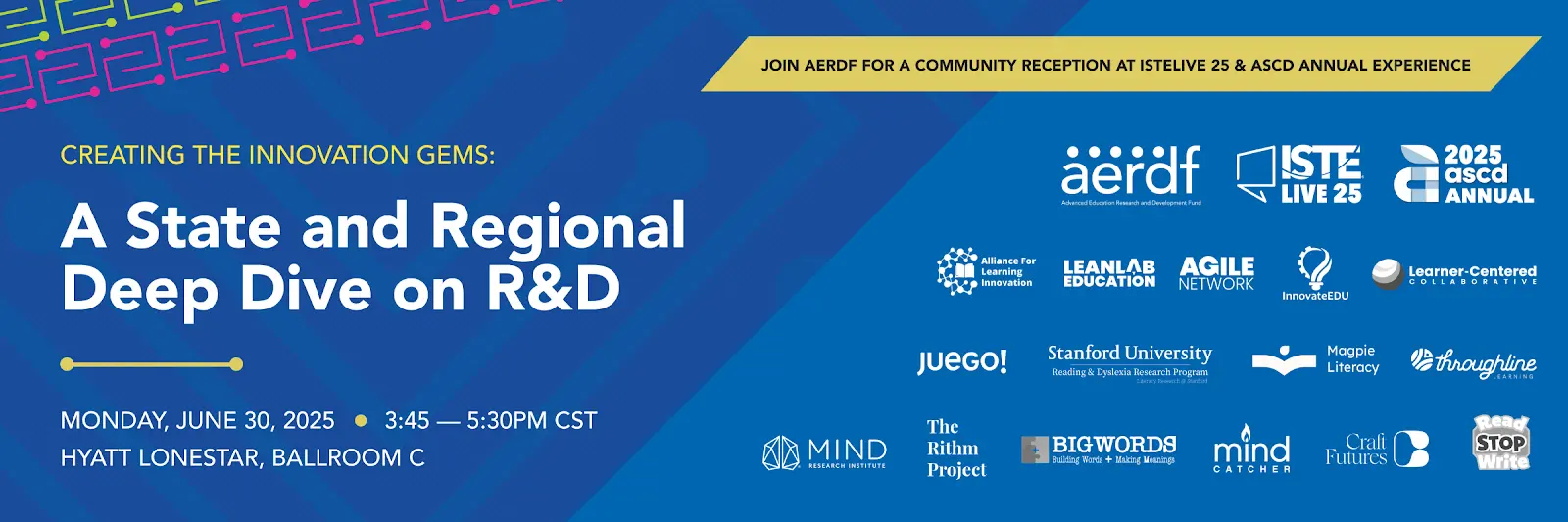
After Day 1 at ISTE and ASCD, educators and leaders from across the country will gather for light refreshments and share some of early inspirations and reflections so far at ISTE and the ASCD Annual Conference. At this informal gathering and reception, hear more about promising developments in teaching and learning across the country, uncover hidden innovation gems, connect with other changemakers, and help shape the future of education R&D.
This is an invitation-only event. Please RSVP by June 26 to confirm attendance.
We’re looking forward to seeing you at ISTELive 25 and the ASCD Annual Conference!
Amid sweeping changes and growing uncertainty in the education sector, one truth remains clear: our nation’s learners are counting on us to deliver on the promise of a transformative education—one that opens doors to opportunity and possibility.
Each day brings new developments, breakthroughs in artificial intelligence, deeper insights into the science of reading, and innovative approaches to supporting students. Yet, at the same time, we face a crumbling federal education infrastructure and a troubling shortage of evidence-based solutions capable of driving real progress in learning outcomes.
Recognizing the critical needs in our nation’s schools, the Advanced Education Research and Development Fund (AERDF) was created to set a higher standard for the instructional solutions that reach our educators and students. We seek out novel approaches that can fundamentally change the future of education rather than pursuing linear, incremental innovation that is likely driven by immediate market opportunities in the EdTech arena.

Since our launch, we have pursued some of the nation’s most pressing PreK-12 teaching and learning challenges or “opportunity areas” that are ripe for new discovery at the edge of existing knowledge. Our R&D programs bridge scientific research with real-world application, from problem analysis and identification, to product design and testing, to product development and evaluation.
At this year’s ASU+GSV Summit, among the over 10,000 leaders in education, technology, and business discussing the current innovations in learning and workforce development, AERDF showcased our latest learnings and inventions across math, literacy, assessment, and AI-augmented teaching.
Below, we take you through those recent developments. Our R&D programs are pushing the boundaries of what’s possible in education, each at a different stage of development but all designed to catalyze advancements in teaching and learning.
Assessment for Good: Assessment in Service of Learning
With a focus on the important transition period from ages 8-13, Assessment For Good (AFG) aims to transform assessment so that it delivers accurate, meaningful data that ignites instruction and provides a holistic picture of learning. Teachers make 1500 decisions a day based on information gleaned from lots of sources: observations, student feedback, and standardized testing data that comes too late and well after the school year has ended, not at the speed of teaching and learning.
AFG is exploring ways we can assess students while they are actively learning and deliver that data immediately.
While most assessments focus on subject mastery, educators are often missing information about foundational skills to understand the next best step to support the learning process. Even more, states across the nation are thinking about how to understand and support each student holistically, to make sure they have all of the skills they need for secondary and post-secondary success.
Assessment has the potential to provide educators, learners, and their families these insights, but current practices provide only a part of the picture and focus almost exclusively on subject matter mastery. This lack of coherence means teachers, learners, or their families aren’t equipped with the most evidence-informed way to support the academic learning for each individual learner.
Since 2022, AFG and its R&D partners have been working on a new breed of assessment that is more about opportunities to learn than about getting an answer right and wrong.
Through the AFG program, we have created assessments that help clarify academic standards and present them in a more useful way for educators.
We are striving to provide educators with each learner’s customized picture of post-secondary success as early as day 1 of 3rd grade. AFG’s prototypes include a comprehensive assessment tool where students receive a dynamic profile that provides a continuous view of learner progress across 30 developmental skills that power learning and matter the most, given where they are in their holistic journey.
These game-based assessments have been used and refined over the last year and a half with R&D partners from Mississippi to Illinois to New York. Not only are these scientifically founded assessments, but they are powered with updated approaches to measurement and understanding growth.
In 2024, AFG built an innovative technical capability that used generative AI as a tool to inform and accelerate assessment development.
Nearly 1,000 assessment items or survey questions were co-created with learners to ensure they reflect learners’ unique skill development and their strengths. Rooted in AFG’s scientific framework and multiple rounds of subject matter expert review, AI generated assessment items were accepted, rejected, or revised for inclusion.


The Fraction Ball team addresses the challenge of teaching rational numbers like fractions and decimals, a crucial step to successfully advancing in math learning. With an emphasis on play and collaboration, Fraction Ball improves students’ understanding of rational numbers and increases joy and happiness in the learning process.
Designed at the suggestion of teachers at El Sol Academy with Dr. Andres Bustamante and his team at UC Irvine, Fraction Ball integrates fractions into the three-point arc and smaller arcs on the basketball court, creating a hands-on, engaging way for students to understand fractions.
The court includes both fraction and decimal representations, helping students visualize their equivalence.

With funding support from EF+Math and in partnership with 3 districts in Southern California, including a foundational relationship with the Santa Ana School District, Fraction Ball has grown to now engage approximately 5,000 students across 33 schools. The team has also engaged with communities in two other countries to continue developing and studying the role of Fraction Ball in supporting students’ math learning experiences.
Five years of experimental studies with thousands of students, have shown moderate to large positive impacts on students’ rational number knowledge outcomes.
Further, evidence shows that participating in Fraction Ball has moderate impacts on students’ emotional experiences by increasing their positive emotions and decreasing negative emotions felt when doing mathematics.
Fraction Ball is one example of EF+Math’s work to co-create and implement math learning experiences that allow every student to effectively leverage their innate assets, including executive function skills, identities, and cultural wealth, to improve math outcomes for all learners.
Reading Reimagined and Rapid Online Assessment of Reading (ROAR): Illuminating Reading’s Hidden Hurdle
New research reveals that many upper elementary and middle-school learners struggle to sound out complex, multisyllabic words and comprehend grade-level text–skills essential for learning. Reading Reimagined aims to end illiteracy by researching and designing classroom-ready solutions that support the linguistic and developmental needs of older elementary students who are not reading at grade level and need to develop foundational reading skills.
Reading Reimagined has brought together partners from Stanford University Graduate School of Education and the Achievement Network (ANet) to test an assessment tool in schools that can help educators identify older students struggling to read.
Their partnership has pioneered the implementation of an effective and efficient assessment tool that accurately measures reading skills in older students: Rapid Online Assessment of Reading (ROAR).

Stanford’s ROAR tool is:
- Free: the assessment is available at no cost.
- Accessible: ROAR is a self-administered assessment that can be completed online by students within 15 minutes, without requiring extensive training or resources from teachers.
- Effective: ROAR is one of two validated reading assessments for students across grades K-12, becoming one of only four approved assessments to assess students for risk of reading difficulties in California.
- Quick and efficient at scale: ROAR offers a fast and reliable way to assess students’ foundational literacy skills on a large scale, helping educators track reading ability and progress across grade levels.
ROAR has been validated through several studies, demonstrating a strong correlation with scores from traditional standardized reading tests, like the Woodcock-Johnson Letter Word Identification test, and gold-standard one-on-one evaluations across diverse student populations, in a fraction of the time.
ROAR is used in over 180 schools and organizations nationwide. It’s approved as a statewide reading screener in California for grades 1 and 2, Minnesota for grades 4 through 12, and Ohio for grades K through 12.
Moving forward, researchers are working to expand ROAR for multilingual learners which would allow students to be assessed in all languages they speak, providing a more comprehensive understanding of their reading skills. As a result teachers will be able to better understand student strengths and areas of need, and provide more precise instructional interventions.
AugmentED: Reimagining the Role of the Teacher for the Age of AI
Our newest R&D program, AugmentED, is working towards ushering in a future where AI enhances and supports human teaching, rather than replacing it.
Unlike traditional technology efforts that engage teachers as product testers, AugmentED will put teachers in the driver’s seat from day one as true co-designers. AugmentED will assemble teams and networks of expert teachers, AI engineers, and computer science and education researchers to co-create new models for teaching and learning for the age of AI and highly effective AI-powered tools that support these new models.
Teams will seek student feedback on their solutions, measure whether they boost student progress, and iterate based on what they learn.
With the potential for transformative impact on both teaching practice and student outcomes, AugmentED aims to create an education system where technology amplifies the irreplaceable human elements of effective instruction while preparing students with the skills they’ll need in an AI-driven world.
AugmentED will focus their initial R&D efforts on high schools, tackling both specific subject areas, such as ELA, and durable skills such as critical thinking and communicating with evidence.
Igniting Discovery. Readying for Scale.
At AERDF, we seed the ripe environment to shape and accelerate nascent, promising, and underexplored ideas into research-backed, ambitious teaching and learning solutions primed to grow and scale within three to five years.
Our pioneering R&D model bridges scientific research with real-world applications by co-designing solutions with educators, students, and caregivers alongside researchers and developers. This approach strengthens the success of the solutions produced because they align with the classroom needs of students and teachers.